Java is a programming language originally developed by James Gosling at Sun Microsystems(which is now a subsidiary of Oracle Corporation) and released in 1995 as a core component of Sun Microsystems' Java platform. The language derives much of its syntax from C and C++ but has a simpler object model and fewer low-level facilities. Java applications are typically compiledto bytecode (class file) that can run on any Java Virtual Machine (JVM) regardless of computer architecture. Java is a general-purpose, concurrent, class-based, object-oriented language that is specifically designed to have as few implementation dependencies as possible. It is intended to let application developers "write once, run anywhere". Java is currently one of the most popular programming languages in use, and is widely used from application software to web applications.[9][10]
The original and reference implementation Java compilers, virtual machines, and class librarieswere developed by Sun from 1995. As of May 2007, in compliance with the specifications of theJava Community Process, Sun relicensed most of its Java technologies under the GNU General Public License. Others have also developed alternative implementations of these Sun technologies, such as the GNU Compiler for Java, GNU Classpath, and Dalvik.
Isnin, 28 Februari 2011
Java(programming Language
Five Element Of Multimedia
Multimedia is comprised of several elements including text, graphics, sound, video, and animation.The K-6 Multimedia kit includes tools and resources for working with each of these elements.Following are brief explanations of each multimedia element and how they can be used:TextText is perhaps the most fundamental element of any multimedia project. Students can useapplications such as AppleWorks and HyperStudio compose and edit their own text. Text-basedinformation can also be gathered from resource CDs and the Internet. Applications such asPhotoshop LE can be used to add visual effects to text to create a more appealing presentation.GraphicsGraphics can be incorporated into a multimedia project in the form of photographs or designs.Graphic images can be imported from a variety of resources such as the Internet, a digital camera,a scanner, or resource CDs such as Art Mania 12,000. Original graphic designs can be created withapplications such as HyperStudio, MovieWorks, and Photoshop LE.SoundSound can be added to a multimedia presentation from a variety of sources. Original sounds can berecorded using a microphone and programs such as HyperStudio, MovieWorks, or SmartSound.These applications, as well as QuickTime Pro, can also be used to import sounds from an audio CDor the Internet. Sound resource files that can be used in multimedia projects are also included onthe HyperStudio, MovieWorks, and SmartSound CDs.VideoMoving images or video can be incorporated into a multimedia project as QuickTime movies.QuickTime Pro, HyperStudio, and MovieWorks can be used with a camcorder or VCR to createand edit QuickTime movies. These programs can also import movies from the Internet and fromresource CDs such as The Archives of History. Movies that can depict a 360-degree panorama or amovable object can also be incorporated into a multimedia project. These virtual reality movies,often referred to as QuickTime VR movies, can be created with QuickTime VR Authoring Studiofor playback and be incorporated into programs such as HyperStudio, MovieWorks, andQuickTime Pro.AnimationGraphics that contain movement are often referred to as animation. Animation files can bedownloaded from the Internet in the form of animated GIF files and viewed with QuickTime Pro,HyperStudio, and MovieWorks. HyperStudio and MovieWorks can also be used to create and editboth frame and path animation.
Selasa, 18 Januari 2011

Difination Of Progaming Language

Isnin, 8 November 2010
Perang cyber

Perang dunia maya/cyber War bukan lagi sekedar fiksi tapi sudah menjadi kenyataan. Perusahaan keamanan jaringan internet McAfee melaporkan saat ini telah terjadi serangan yang dilakukan melalui jaringan internet.
Dari analisa yang dilakukan, serangan yang terjadi di dunia maya ini sebagian besar bermotif politik. Bahkan saat ini banyak negara yang telah mempersenjatai diri dalam perang cyber dan menyiapkan pasukan untuk melakukan serangan secara virtual, sebelum menyerang secara fisik.
"Setidaknya ada lima negara diketahui mempersenjatai diri mereka sendiri untuk menghadapi konflik via jaringan internet yang akan terjadi di masa depan," kata Greg Day, analis utama McAfee Eropa. Negara itu adalah Inggris, Jerman, Prancis, China dan Korea Utara.
Meski belum ada definisi sebenarnya perang cyber, namun para pengamat menilai perang tersebut adalah saling serang untuk mencuri informasi rahasia suatu negara. "Jika seseorang mencuri informasi atau menanamkan bom logika, maka itu akan sulit sekali dilacak," kata Chris Wysopal dari Veracode.
AS diketahui memiliki petunjuk manual aturan dan prosedur untuk menjalankan taktik perang cyber. Hal ini diketahui ketika AS melakukan hacking terhadap seluruh jaringan cyber di Irak sebelum melakukan serangan fisik. AS dengan mudah mengetahui posisi tentara Irak, termasuk kekuatan persenjataan mereka, sehingga memudahkan operasi tentara AS.
"Kalau langsung perang fisik akan butuh biaya besar, tapi kalo perang cyber akan lebih murah dan efektif," kata Day. Ia menambahkan salah satu incaran dalam perang cyber di masa depan adalah infrastruktur, karena ini menyangkut hajat hidup orang banyak.
Sumber - Mediaindonesia
Jenayah Cyber
Siberkeganasan
Gambaran keseluruhan
Apabila Internet menjadi semakin merebak dalam semua jurusan ikhtiar manusia, individu atau kumpulan yang dapat menggunakan anonymity yang dimampu oleh ruang siber untuk mengugut warga, kumpulan khusus (iaitu dalam keahlian berasaskan etnik atau kepercayaan), masyarakat dan keseluruhan negera-negara, tanpa mewarisi ugutan penangkapan, kecedaraan, atau kematian pada penyerang yang menjadi hadir secara fizikal akan membawa.
Apabila Internet terus mengembang, dan sistem komputer terus ditugaskan lebih tanggung jawab sementara menjadi semakin kompleks dan saling bergantung, sabotaj atau keganasan melalui ruang siber boleh menjadi ugutan semakin serius.
Takrifan asas
Siberkeganasan adalah mengumpil suatu komputer dan maklumat sasaran, khususnya melalui Internet, untuk menyebabkan gangguan kecederaan dunia benar atau gangguan teruk infrastruktur.
Siberkeganasan ditakrifkan sebagai “Kegunaan terancang terlebih dahulu aktiviti-aktiviti menggangu, atau mengugut dari itu, terhadap komputer dan/atau rangkaian, dengan niat untuk menyebab kecederaan atau masyarakat, ideologi, politik atau objektif mirip yang lanjut. Atau untuk mengancam mana-mana orang dalam kelanjutan objektif seperti itu.” Takrifan ini telah diciptakan oleh Kevin G. Coleman dari Technolytics Institute.[1]
...tergolong dari masa ke masa untuk melingkungi benda-benda seperti itu dengan hanya merosakkan sebuah laman atau pelayan web, atau menyerang sistem bukan-kritikal, menyebabkan istilah itu menjadi kurang berguna...
Ada sesetengah yang berkata siberkeganasan tidak wujud dan adalah sebenarnya suatu hal menggodam atau konflik maklumat. Mereka tidak bersetuju dengan melabelnya keganasa oleh kerana ketidakmungkinan berlakunya ketakutan, kecederaan fizikal besar, atau kematian dalam sebuah penduduk dengan menggunakan cara elektronik, menganggapkan serangan dan teknologi berlindung kini.
National Conference of State Legislatures (NCSL), sebuah pertubuhan dwipemihak penggubal undang-undang dan kakitangan mereka ditubuh untuk membantu dari kesemua 50 negara mengalamatkan isu-isu penting seperti yang melibatkan ekonomi atau kawalan tanah air dengan memperuntukkan mereka dengan sebuah forum untuk menukar gagasan, mengongsi penyelidikan dan memperolehi bantuan teknikal [1] defines cyberterrorism as follows:
kegunaan teknologi oleh kumpulan pengganas dan individu untuk melanjutkan agenda mereka. Ini dapat termasuk kegunaan teknologi maklumat untuk mengatur dan melaksanakan serangan terhadap rangkaian, ke dalam sistem komputer, memperkenalkan virus pada rangkaian mudah diserang, merosakkan laman web,serangan penafian-khidmat, atau ugutan berpengganas melalui komunikasi elektronik. [2] Demitri Jesus Olmo.
[sunting] Maklumat latar belakang
Kecenderungan am pada siberkeganasan bermula pada lewat 1980-an. Apabila tahun 2000 tiba, ketakutan dan ketidakpastian mengenai pepijat alaf memuncakkan dan kecenderungan pada serangan siberpenggas berpotensi telah bertambah. Meskipun, walaupun pijat alaf adalah dengan tiada makna suatu serangan pengganas atau komplot terhadap dunai atau Amerika Syarikat, ia telah bertindak sebagai sebuah mangkin dalam mencetuskan ketatukan serangan siber dahsyat dengan skala besar. Pengulas menyatakan bahawa banyak fakta peristiwa seperti itu kelihat berubah, sering dengan laporan massa yang menokok tambah.
Serangan pengganas profail tinggi di Amerika Syarikat pada September 11, 2001 membawa pada liputan massa yang lebih ugutan siberkenagasan dalam tahun-tahun berikutnya. Liputan massa arus sering membincangkan kemungkinan serangan besar menggunakan rangkaian komputer pada infrastruktur kritikal sabotaj dengan tujuan meletakkan hidup manusia dalam bahaya atau menyebabkan gangguan pada skala negara secara lanjut atau dengan mengganggu ekonomi negara.
Pengarang seperti Winn Schwartau dan John Arquilla melaporkan telah mempunyai kejayaan kewangan agak banyak menjual buku yang menjelaskan apa yang dimaksudkan senario munasabah huru-hara disebabkan oleh siberkeganasan. Banyak pengkritik mendakwa bahawa buku-buku ini adalah tidak realistik pada taksiran mereka sama ada serangan dijelaskan (seperti cairan nuklear dan letupan bangunan kimia) berkemungkinan. Suatu benang umum di sepanjang apa yang pengkritik bertanggap sebagai penipuan siberkenagasan adalah yang bukan-kepalsuan; iaitu, apabila bencana diramalkan gagl untuk berpunca, ia hanya pergi menunjukkan bagaimana nasib baik jadinya kita, daripada mempersoalkan teori.
[sunting] Kesan
Siberkenagasan dapat mempunyai pengaruh skala besar serius pada bilangan besar orang. Ia dapat melemahkan ekonomi secara besar, oleh itu stripping it of its resources and making it more vulnerable to military attack.
Siberkenagasan juga dapat melibatkan bisnes asas internet. Seperti peruncit dan peruntuk khidmat batu-bata dan mortar, kebanyakan laman web yang menghasilkan income (sama ada oleh keiklanan, penukaran wang untuk barangan atau khidmat dibayar) dapat bertahan menghilangkan wang dalam peristiwa masa rosak diciptakan oleh penjenayah siber.
Apabila bisnes internet menambahkan kepentingan ekonomi pada negara-negara, apa yang biasanya jenayah siber menjadi lebih berkenaan politik dan oleh itu berkaitan "keganasan".
[sunting] Contoh
Salah satu contoh pengganas siber bekerja adalah apabila para pengganasa di Romania mencapai secara haram pada komputer mengawal sistem sokongan hidup di sebuah stesen penyelidikan Antartika, membahayakan 58 ahli sains. Meskipun, pesalah telah dihentikan sebelum kerosakan sebenarnya berlaku. Kebanyakan tindakan bukan politik sabotaj telah menyebabkan kerosakan kewangan dan yang lain, seperti dalam perkara di mana seorang pekerja bersungut menyebabkan pengeluaran kumbahan ke dalam air di Maroochy Shire, Australia. [3] Virus komputer telah menurun pangkat atau mematikan sesetengah sistem bukan sangat penting dalam kilang tenaga nuklear, tetapi ini tidak dipercayai telah menjadi suatu serangan sengaja dilakukan.
Lebih baru-baru ini, pada Mei 2007 Estonia telah ditaklukkan suatu siberserangan secara besar-besaran dalam kebangkitan pengalihan tugu perang Perang Dunia II Rusia dari pusat bandar Talinn. Serangan adalah suatu serangan penafian khidmat di mana laman-laman pilihan telah dihujani dengan kesesakan supaya dapat memaksa mereka secara offline; hampir semua rangkaian kementerian Estonia dan juga dua rangkaian bank Estonia telah diserang secara offline; tambahan, laman web parti politik Perdana Menteri Estonia kini Andrus Ansip mencirikan sebuah surat pengampunan dari Ansip oleh kerana mengalihkan patung peringatan. Sungguhpun spekulasi bahawa serangan telah dikoordinatkan oleh kerajaan Rusia, menteri pertahanan Estonia mengaku dia tidak mempunyai bukti memautkan serangan siber terhadap pihak berkuasa Rusia. Rusia memanggil tuduhan kelibatan ini "tidak ditemukan", dan bukan sama ada NATO ataupun pakar Jawatankuasa Eropah dapat mencari mana-mana bukti penyertaan kerajaan Rusia rasmi.[3] Pada Januari 2008 seorang lelaki dari Estonia telah dihukum oleh kerana melancarkan serangan terhadap laman web Parti Pembaharuan Estonia dan didenda.[4][5]
Lebih lanjutnya, pada Oktober 2007, laman web presiden Ukraine Viktor Yushchenko telah diserang oleh penggodam. Sebuah kumpulan pemuda nasionalis Rusia, Gerakan Pemuda Eruasian, mendakwa tanggung jawab.[6]
Sejak dunia komputer adalah semakin menbesar dan masih lagi secara besar tidak dijelajahi, negara-negara yang baru dengan dunia siber menghasilkan ahli sains komputer baru yang biasanya minat pada "mencari kenikmatan". Negara-negara seperti China, Greece, India, Israel, dan Korea Selatan telah semua berada dalam spotlight terdahulunya oleh Media A.S. dengan serangan pada sistem maklumat berkaitan dengan CIA dan NSA. Walaupun serangan ini biasanya sebabnya pengacara komputer muda, Amerika Syarikat telah mempunyai lebih daripada kebimbangan sah tentang kawalan negara apabila sistem maklumat kritikal seperti itu berada di bawah serangan. Selama lima tahun, Amerika Syarikat telah mengambil suatu kepentingan lebih besar dalam melindungi sistem maklumatnya yang kritikal. Ia telah mengisukan kontrak untuk penyelidikan taraf lebih tinggi pada negara seperti Greece dan Israel, untuk membantu melindung terhadap serangan lebih serius dan bahaya.
Pada 1999 penggodam menyerang komputer-komputer NATO. Komputer-komputer itu membanjiri mereka dentgan email dan menyerang mereka dengan denial of service (DoS). Para penggodam itu telah menunjuk perasaan terhadap letupan bom NATO di Kosovo. Bisnes-bisnes, pertubuhan am dan institusi akademik telah dihujani dengan email-email bertujuan politik tinggi mengandungi virus dari negara-negara Eropah lain.[7]
[sunting] Tindak balas
Jabatan Pertahanan AS mendakwa United States Strategic Command dengan tugas memerangi siberkeganasan. Ini telah dicapai melalui melalui Joint Task Force-Global Network Operations (JTF-GNO). JTF-GNO adalah sebuah komponen beroperasi meyokong USSTRATCOM dalam pertahanan Global Information Grid DoD. Ini dilakukan dengan menyatukan kemahiran GNO ke dalam operasi semua komputer, rangkaian, dan sistem DoD digunakan oleh DoD combatant commands, services and agencies.
Pada November 2, 2006, Setiausaha Tentera Udara mengumumkan penciptaan MAJCOM terbaru Tentera Udara, Air Force Cyber Command, yang akan ditugaskan untuk memantau dan mempertahankan kepentingan Amerika pada ruang siber. Rancangan itu meskipun telah digantikan oleh penciptaan Twenty-Fourth Air Force yang menjadi aktif pada Ogos 2009 dan akan menjadi suatu komponen United States Cyber Command yang dirancang.
Pada Disember 22, 2009, White House menggelarkan ketua White House Cyber Security sebagai Howard Schmidt. Dia akan mengkordinatkan usaha Kerajaan, ketenteraan dan pengintip A.S. untuk menangkis penggodam.
[sunting] Dalam fiksyen
- Manga siberpunk Jepun, Ghost in the Shell (dan juga wayang masyhurnya dan serapan TV) berpusat di sekitar sebuah unit anti-siberkeganasan dan jenayah siber. Dalam muatan pertengahan kurun ke-21 Jepun serangan seperti itu membuatkan lebih mengancam dengan kegunaan lebih tersebar teknologi termasuk penambahan sibernetik pada tubuh manusia membenarkan orang sendiri untuk menjadi sasaran lanjut serangan siberpengganas.
- Siberkeganasan telah dicirikan dalam Digital Fortress Dan Brown.
- Siberkeganasan telah dicirikan dalam Private Lies Amy Eastlake.
- Dalam wayang Live Free or Die Hard, John McClane (Bruce Willis) mengambil sekumpulan niat siberpengganas dengan niat mematikan keseluruhan rangkaian komputer Amerika Syarikat.
- Wayang Eagle Eye terlibat sebuah komputer hebar mengawal semua yang mempunyai elektrik dan rangkaian untuk mencapai tujuan matlamat.
- Jalan cerita 24 Day 4 dan kini Day 7 termasuk rancangan untuk melanggar grid kilang nuklear negara dan kemudian mengambil alih keseluruhan protokol infrastruktur kritikal.
- The Tom Clancy menciptakan siri Netforce adalah mengenai pasukan FBI/Ketenteraan berdedikasi memerangi siberpengganas.
- Kebanyakan jalan cerita Mega Man Battle Network berpusat di keliling siberpengganas.
[sunting] Senarai bacaan
- Alexander, Yonah Swetman, Michael S. (2001). Cyber Terrorism and Information Warfare: Threats and Responses, Transnational Publishers Inc.,U.S.. ISBN 1-57105-225-9.
- Colarik, Andrew M. (2006). Cyber Terrorism: Political and Economic Implications, Idea Group,U.S.. ISBN 1-59904-022-0.
- Verton, Dan (2003). Black Ice: The Invisible Threat of Cyber-terrorism, Osborne/McGraw-Hill,U.S.. ISBN 0-07-222787-7.
- Weimann, Gabriel (2006). Terror on the Internet: The New Arena, the New Challenges, United States Institute of Peace,U.S.. ISBN 1-929223-71-4.
[sunting] Lihat juga
- Anonymous
- Siberbuli
- Operasi siber
- Siber-hendap
- Intifada
- Internet dan keganasan
- US-CERT (United States Computer Emergency Readiness Team)
- Godaman patriot
- Siberserangan terhadap Estonia 2007
- Siberserangan sewaktu perang Ossetia Selatan 2008
- IMPACT @ ITU Global Cybersecurity Agenda
[sunting] Rujukan
- ↑ 1.0 1.1 http://stinet.dtic.mil/cgi-bin/GetTRDoc?AD=ADA439217&Location=U2&doc=GetTRDoc.pdf
- ↑ Afroz, Soobia (June 16, 2002). "Cyber terrorism — fact or fiction?". Dawn. http://www.dawn.com/weekly/dmag/archive/020616/dmag21.htm. Retrieved 2008-08-30.
- ↑ Estonia tiada bukti kelibatan Kremlin pada serangan siber
- ↑ "Estonia fines man for 'cyber war'", BBC, 2008-01-25. Dicapai pada 2008-02-23.
- ↑ Leyden, John (2008-01-24), "Estonia fines man for DDoS attacks", The Register, http://www.theregister.co.uk/2008/01/24/estonian_ddos_fine, retrieved 2008-02-22
- ↑ Russian nationalists claim responsibility for attack on Yushchenko's Web site International Herald Tribune
- ↑ CNN - Hackers attack U.S. government Web sites in protest of Chinese embassy bombing - May 10, 1999
[sunting] Bacaan lanjut
- Blau, John (Nov 2004) “The battle against cyberterror” NetworkWorld. Retrieved Mar 20, 2005 from the World Wide Web: http://www.nwfusion.com/supp/2004/cybercrime/112904terror.html
- Gross, Grant (Nov 2003) “Cyberterrorist attack would be more sophisticated that past worms, expert says” ComputerWorld. Retrieved Mar 17, 2005 from the World Wide Web: http://www.computerworld.com/securitytopics/security/story/0,10801,86857,00.html
- Poulsen, Kevin (Aug 2004) “South Pole ‘cyberterrorist’ hack wasn’t the first” SecurityFocus News. Retrieved Mar 17, 2005 from the World Wide Web: http://www.securityfocus.com/news/9356.
- Thevenet, Cédric (Nov 2005) "Cyberterrorisme, mythe ou réalité?". From the World Wide Web : http://www.terrorisme.net/pdf/2006_Thevenet.pdf
- U.S. Army Cyber Operations and Cyber Terrorism Handbook 1.02
[sunting] Pautan luar
[sunting] Umum
- What is Cyberterrorism? Even experts can't agree in the Harvard Law Record
- AIC Australian Institute of Criminology - Cyberterrorism
- CRS Report for Congress - Computer Attack and Cyber Terrorism - 17/10/03
- Statement for the Record of Louis J. Freeh, Director Federal Bureau of Investigation on Cybercrime - Mar 28, 2000
- Cyber-Terrorism: Propaganda or Probability?
- FBI Laboratory - Cyberterrorism: Fact or Fancy by Mark M. Pollitt
- How terrorists use the internet ABC Australia interview with Professor Hsinchun Chen on the Dark internet.
- Department of Defense Cyber Crime Center
- Documentary about Cyberterrorism (in Spanish)
- [4]
- [5]
- Cyber Terrorism by Internet Security Visionary Melih Abdulhayoglu
[sunting] Berita
- Politically Motivated Computer Crime - Current news on political hacking
- MSNBC - Hacker plan: take down the Net - Mar 3, 2000
- BBC News - Cyber terrorism 'overhyped' - 14/03/03
- BBC News - US warns of al-Qaeda cyber threat - 01/12/06
- NDTV News - Terror in cyber space toughest to check - 09/12/08
- Wanabehuman - modern militant, counter-terror use of the internet - 25/01/07
- Wanabehuman - approaches to understanding radicalization - 02/05/07
Selasa, 2 November 2010

Selasa, 29 Jun 2010
differences between internet,intranet and extranet
There's one major distinction between an intranet and the Internet: The Internet is an open, public space, while an intranet is designed to be a private space. An intranet may be accessible from the Internet, but as a rule it's protected by a password and accessible only to employees or other authorized users. From within a company, an intranet server may respond much more quickly than a typical Web site. This is because the public Internet is at the mercy of traffic spikes, server breakdowns and other problems that may slow the network. Within a company, however, users have much more bandwidth and network hardware may be more reliable. This makes it easier to serve high bandwidth content, such as audio and video, over an intranet. (unless you work for the United States Marine Corps. Then you don't get to watch video's. And they Block 80% of any kind of "fun" or entertaining website available on the Internet) The Extranet is a portion of an organization's Intranet that is made accessible to authorized outside users without full access to an entire organization's intranet.


Ahad, 27 Jun 2010
Network Tropology

Network Architecture
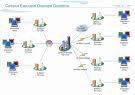
Computer Network
A computer network allows sharing of resources and information among devices connected to the network. The Advanced Research Projects Agency (ARPA) funded the design of the Advanced Research Projects Agency Network (ARPANET) for the United States Department of Defense. It was the first operational computer network in the world.[1] Development of the network began in 1969, based on designs developed during the 1960s. For a history see ARPANET, the first network.[edit] PurposeComputer networks can be used for several purposes:Facilitating communications. Using a network, people can communicate efficiently and easily via e-mail, instant messaging, chat rooms, telephony, video telephone calls, and videoconferencing.Sharing hardware. In a networked environment, each computer on a network can access and use hardware on the network. Suppose several personal computers on a network each require the use of a laser printer. If the personal computers and a laser printer are connected to a network, each user can then access the laser printer on the network, as they need it.Sharing files, data, and information. In a network environment, any authorized user can access data and information stored on other computers on the network. The capability of providing access to data and information on shared storage devices is an important feature of many networks.Sharing software. Users connected to a network can access application programs on the network.
Information System
An Information System (IS) is any combination of information technology and people's activities using that technology to support operations, management, and decision-making.[1] In a very broad sense, the term information system is frequently used to refer to the interaction between people, algorithmic processes, data and technology. In this sense, the term is used to refer not only to the information and communication technology (ICT) an organization uses, but also to the way in which people interact with this technology in support of business processes[2].
Some make a clear distinction between information systems, ICT and business processes. Information systems are distinct from information technology in that an information system is typically seen as having an ICT component. Information systems are also different from business processes. Information systems help to control the performance of business processes [3].
Alter argues for an information system as a special type of work system. A work system is a system in which humans and/or machines perform work using resources (including ICT) to produce specific products and/or services for customers. An information system is a work system whose activities are devoted to processing (capturing, transmitting, storing, retrieving, manipulating and displaying) information [4].
Part of the difficulty in defining the term information system is due to vagueness in the definition of related terms such as system and information. Beynon-Davies argues for a clearer terminology based in systemics and semiotics. He defines an information system as an example of a system concerned with the manipulation of signs. An information system is a type of socio-technical system. An information system is a mediating construct between actions and technology [5].
As such, information systems inter-relate with data systems on the one hand and activity systems on the other. An information system is a form of communication system in which data represent and are processed as a form of social memory. An information system can also be considered a semi-formal language which supports human decision making and action.
Information systems are the primary focus of study for the information systems discipline and for organisational informatics[6].
Program Development Phase
To make a program, the programmer has to undergo several phases and which will determine how and what the program he should make.
Firstly, the programmer has to undergo the analyzing phase. In this phase, the programmer has to conduct a survey to determine the problem faced by the client and know the target user.
Then, the programmer will begin the design phase. In the design phase, the programmer has to design the program and draw them out as a pseudo code, flow chart or top down design model.
Next is the coding phase. In the coding phase, the programmer will begin his work on coding the program. The coding is usually be done by several programmer as a complex program consist of many syntax.
Testing and debugging phase are the next phase. Here the program done will be tested to ensure that is error free. The usual error is the syntax error, logic error and run-time error. This phase is also called debugging because the error occurred are also known as bug.
Finally it is the documentation phase. Documentation is also including internal documentation and marketing documentation. Internal documentation is made so that the programmer can easily edit the code in the future. It also enables other programmer to know how the program is coded so that they can also improve it. Marketing documentation is done so that the customer can have a better understanding on the program. This will also enable the potential customer to compare the program with other product and expect what they could gain from the program.
Selasa, 22 Jun 2010
Progaming Process
IntroductionComputer programs are collections of instructions that tell a computer how to interact with the user, interact with the computer hardware and process data. The first programmable computers required the programmers to write explicit instructions to directly manipulate the hardware of the computer. This "machine language" was very tedious to write by hand since even simple tasks such as printing some output on the screen require 10 or 20 machine language commands. Machine language is often referred to as a "low level language" since the code directly manipulates the hardware of the computer.By contrast, higher level languages such as "C", C++, Pascal, Cobol, Fortran, ADA and Java are called "compiled languages". In a compiled language, the programmer writes more general instructions and a compiler (a special piece of software) automatically translates these high level instructions into machine language. The machine language is then executed by the computer. A large portion of software in use today is programmed in this fashion.We can contrast compiled programming languages with interpreted programming languages. In an interpreted programming language, the statements that the programmer writes are interpreted as the program is running. This means they are translated into machine language on the fly and then execute as the program is running. Some popular interpreted languages include Basic, Visual Basic, Perl and shell scripting languages such as those found in the UNIX environment.We can make another comparison between two different models of programming. In structured programming, blocks of programming statements (code) are executed one after another. Control statements change which blocks of code are executed next.In object oriented programming, data are contained in objects and are accessed using special methods (blocks of code) specific to the type of object. There is no single "flow" of the program as objects can freely interact with one another by passing messages.In this tutorial, we focus only on structured programming.Program StructureVirtually all structured programs share a similar overall structure:Statements to establish the start of the programVariable declarationProgram statements (blocks of code)The following is a simple example of a program written in several different programming languages. We call this the "Hello World" example since all the program does is print "Hello World" on the computer screen.LanguageExample program"C"#includevoid main() {printf("Hello World");}C++#includeint main(){coutPascalprogram helloworld (output);beginwriteln('Hello World');end.Oracle PL/SQLCREATE OR REPLACE PROCEDURE helloworld ASBEGINDBMS_OUTPUT.PUT_LINE('Hello World');END;Javaclass helloworld{public static void main (String args []){System.out.println ("Hello World");}}Perl#!/usr/local/bin/perl -wprint "Hello World";Basicprint "Hello World"
Multimedia Introduction
1 INTRODUCTIONAs the name suggests, multimedia is a set of more than one media element used to produce a concrete and more structured way of communication. In other words multimedia is simultaneous use of data from different sources. These sources in multimedia are known as media elements. With growing and very fast changing information technology, Multimedia has become a crucial part of computer world. Its importance has realised in almost all walks of life, may it be education, cinema, advertising, fashion and what not.Throughout the 1960s, 1970s and 1980s, computers have been restricted to dealing with two main types of data - words and numbers. But the cutting edge of information technology introduced faster system capable of handling graphics, audio, animation and video. And the entire world was taken aback by the power of multimedia.35.2 OBJECTIVESAfter going through this lesson you should be able toexplain what is multimediaunderstand the importance of individual media elementsidentify different hardware components required to run a multimediaappreciate the impact of audio in educational presentationdescribe how visual images, graphics and audio can be added to a presentationenhance the capability of multimedia through interactive video impact35.3 WHAT IS MULTIMEDIA?Multimedia is nothing but the processing and presentation of information in a more structured and understandable manner using more than one media such as text, graphics, animation, audio and video. Thus multimedia products can be an academic presentation, game or corporate presentation, information kiosk, fashion-designing etc. Multimedia systems are those computer platforms and software tools that support the interactive uses of text, graphics, animation, audio, or motion video. In other words, a computer capable of handling text, graphics, audio, animation and video is called multimedia computer. If the sequence and timing of these media elements can be controlled by the user, then one can name it as Interactive Multimedia.35.4 DIFFERENT MEDIA ELEMENTS(i) TextInclusion of textual information in multimedia is the basic step towards development of multimedia software. Text can be of any type, may be a word, a single line, or a paragraph. The textual data for multimedia can be developed using any text editor. However to give special effects, one needs graphics software which supports this kind of job. Even one can use any of the most popular word processing software to create textual data for inclusion in multimedia. The text can have different type, size, color and style to suit the professional requirement of the multimedia software.(ii) GraphicsAnother interesting element in multimedia is graphics. As a matter of fact, taking into consideration the human nature, a subject is more explained with some sort of pictorial/graphical representation, rather than as a large chunk of text. This also helps to develop a clean multimedia screen, whereas use of large amount of text in a screen make it dull in presentation.Unlike text, which uses a universal ASCII format, graphics does not have a single agreed format. They have different format to suit different requirement. Most commonly used format for graphics is .BMP or bitmap pictures. The size of a graphics depends on the resolution it is using. A computer image uses pixel or dots on the screen to form itself. And these dots or pixel, when combined with number of colors and other aspects are called resolution. Resolution of an image or graphics is basically the pixel density and number of colors it uses. And the size of the image depends on its resolution. A standard VGA (Virtual Graphics Arrays) screen can display a screen resolution of 640 ´ 480 = 307200 pixel. And a Super VGA screen can display up-to 1024 ´ 768 = 786432 pixel on the screen. While developing multimedia graphics one should always keep in mind the image resolution and number of colors to be used, as this has a direct relation with the image size. If the image size is bigger, it takes more time to load and also requires higher memory for processing and larger disk-space for storage.However, different graphics formats are available which take less space and are faster to load into the memory.There are several graphics packages available to develop excellent images and also to compress them so that they take lesser disk-space but use higher resolution and more colours. Packages like Adobe PhotoShop, Adobe Illustrator, PaintShop Pro etc. are excellent graphics packages. There are Graphics gallery available in CD’s (Compact Disk) with readymade images to suit almost every requirement. These images can directly be incorporated into multimedia development.(iii) AnimationMoving images have an overpowering effect on the human peripheral vision. Followings are few points for its popularity.Showing continuity in transitions:Animation is a set of static state, related to each other with transition. When something has two or more states, then changes between states will be much easier for users to understand if the transitions are animated instead of being instantaneous. An animated transition allows the user to track the mapping between different subparts through the perceptual system instead of having to involve the cognitive system to deduce the mappings.Indicating dimensionality in transitions:Sometimes opposite animated transitions can be used to indicate movement back and forth along some navigational dimension. One example used in several user interfaces is the use of zooming to indicate that a new object is "grown" from a previous one (e.g., a detailed view or property list opened by clicking on an icon) or that an object is closed or minimized to a smaller representation. Zooming out from the small object to the enlargement is a navigational dimension and zooming in again as the enlargement is closed down is the opposite direction along that dimension.Illustrating change over timeSince animation is a time-varying display, it provides a one-to-one mapping to phenomena that change over time. For example, deforestation of the rain forest can be illustrated by showing a map with an animation of the covered area changing over time.

Isnin, 21 Jun 2010
Multimedia Concept
1 INTRODUCTIONAs the name suggests, multimedia is a set of more than one media element used to produce a concrete and more structured way of communication. In other words multimedia is simultaneous use of data from different sources. These sources in multimedia are known as media elements. With growing and very fast changing information technology, Multimedia has become a crucial part of computer world. Its importance has realised in almost all walks of life, may it be education, cinema, advertising, fashion and what not.Throughout the 1960s, 1970s and 1980s, computers have been restricted to dealing with two main types of data - words and numbers. But the cutting edge of information technology introduced faster system capable of handling graphics, audio, animation and video. And the entire world was taken aback by the power of multimedia.35.2 OBJECTIVESAfter going through this lesson you should be able toexplain what is multimediaunderstand the importance of individual media elementsidentify different hardware components required to run a multimediaappreciate the impact of audio in educational presentationdescribe how visual images, graphics and audio can be added to a presentationenhance the capability of multimedia through interactive video impact35.3 WHAT IS MULTIMEDIA?Multimedia is nothing but the processing and presentation of information in a more structured and understandable manner using more than one media such as text, graphics, animation, audio and video. Thus multimedia products can be an academic presentation, game or corporate presentation, information kiosk, fashion-designing etc. Multimedia systems are those computer platforms and software tools that support the interactive uses of text, graphics, animation, audio, or motion video. In other words, a computer capable of handling text, graphics, audio, animation and video is called multimedia computer. If the sequence and timing of these media elements can be controlled by the user, then one can name it as Interactive Multimedia.35.4 DIFFERENT MEDIA ELEMENTS(i) TextInclusion of textual information in multimedia is the basic step towards development of multimedia software. Text can be of any type, may be a word, a single line, or a paragraph. The textual data for multimedia can be developed using any text editor. However to give special effects, one needs graphics software which supports this kind of job. Even one can use any of the most popular word processing software to create textual data for inclusion in multimedia. The text can have different type, size, color and style to suit the professional requirement of the multimedia software.(ii) GraphicsAnother interesting element in multimedia is graphics. As a matter of fact, taking into consideration the human nature, a subject is more explained with some sort of pictorial/graphical representation, rather than as a large chunk of text. This also helps to develop a clean multimedia screen, whereas use of large amount of text in a screen make it dull in presentation.Unlike text, which uses a universal ASCII format, graphics does not have a single agreed format. They have different format to suit different requirement. Most commonly used format for graphics is .BMP or bitmap pictures. The size of a graphics depends on the resolution it is using. A computer image uses pixel or dots on the screen to form itself. And these dots or pixel, when combined with number of colors and other aspects are called resolution. Resolution of an image or graphics is basically the pixel density and number of colors it uses. And the size of the image depends on its resolution. A standard VGA (Virtual Graphics Arrays) screen can display a screen resolution of 640 ´ 480 = 307200 pixel. And a Super VGA screen can display up-to 1024 ´ 768 = 786432 pixel on the screen. While developing multimedia graphics one should always keep in mind the image resolution and number of colors to be used, as this has a direct relation with the image size. If the image size is bigger, it takes more time to load and also requires higher memory for processing and larger disk-space for storage.However, different graphics formats are available which take less space and are faster to load into the memory.There are several graphics packages available to develop excellent images and also to compress them so that they take lesser disk-space but use higher resolution and more colours. Packages like Adobe PhotoShop, Adobe Illustrator, PaintShop Pro etc. are excellent graphics packages. There are Graphics gallery available in CD’s (Compact Disk) with readymade images to suit almost every requirement. These images can directly be incorporated into multimedia development.(iii) AnimationMoving images have an overpowering effect on the human peripheral vision. Followings are few points for its popularity.Showing continuity in transitions:Animation is a set of static state, related to each other with transition. When something has two or more states, then changes between states will be much easier for users to understand if the transitions are animated instead of being instantaneous. An animated transition allows the user to track the mapping between different subparts through the perceptual system instead of having to involve the cognitive system to deduce the mappings.Indicating dimensionality in transitions:Sometimes opposite animated transitions can be used to indicate movement back and forth along some navigational dimension. One example used in several user interfaces is the use of zooming to indicate that a new object is "grown" from a previous one (e.g., a detailed view or property list opened by clicking on an icon) or that an object is closed or minimized to a smaller representation. Zooming out from the small object to the enlargement is a navigational dimension and zooming in again as the enlargement is closed down is the opposite direction along that dimension.Illustrating change over timeSince animation is a time-varying display, it provides a one-to-one mapping to phenomena that change over time. For example, deforestation of the rain forest can be illustrated by showing a map with an animation of the covered area changing over time
Software Requiment
A Software Requirements Specification (SRS) is a complete description of the behavior of the system to be developed. It includes a set of use cases that describe all the interactions the users will have with the software. Use cases are also known as functional requirements. In addition to use cases, the SRS also contains non-functional (or supplementary) requirements. Non-functional requirements are requirements which impose constraints on the design or implementation (such as performance engineering requirements, quality standards, or design constraints


 Kuala Lumpur Time